Thursday, January 3, 2019

On This Day - January 3rd

ROBERT SIMMONS 1758- bef 1844 and probably bef 1830.

   THE FACTS
        Robert  Simmons was born on January 3, 1758 in Abbeville District, South Carolina. It is believed that he is the son of John and Ann (Pickens) Simmons although some have John's brother Benjamin as Robert's father. Robert served during the Revolutionary war in Anderson's Regiment. He married Ann Miller (1762-1843) on 8 Sep 1781 in Abbeville.  She is the daughter of Robert Miller and Jane Pickens. They had eight children. The family was in Abbeville for the 1800 census but by December of 1801 they were on a journey taking them to Louisiana. Anne's brother Robert had gone to Louisiana shortly after the Revolution. The fact that he had been a loyalist most likely prompted his move. The following letter was written to Ann's mother:

     13 December 1801, Tennessee State
     Jefferson District French Broad River
     thirty miles below Warm Springs
     Dear Moter,
        We take the opertunity of wrightin to let you know that we are all well at preasent but Bekey, and she has got the ague, but we hope youar well. I wrout to you before about our jurney. I know not wheather you got it or not. Odom lefte me about Sixteen Miles before we stoped and was at me to get into helpe make a boat, but I turned him of for his past conduct on the Road and I know not what has become of him since, and am makeing a boat Myself and will have it don in three or four weke. We wold bee glad you cold come and go down with us as you will never have a beter chanc again. If you cold come by the midel of next Month, we are settled with sober people and have preaching once in too weeks. It is a prisbetarin minnistar by the name of Henderson. We have got a house free while we stay in thes parts. We wuld be glad to see you hear. i think some of the boys might come with you and fetch jinin with you or send her as jean is very uneasey about her.  We has nomor at present, but remain your Most Obedient Son & Daughter until death. Robert & Anne Simmons

   I have seen mentioned that Robert is noted on the Indian Agent's records as being given a pass to go by flatboat down the Tennessee River to Mississippi River to Natchez in 1802 with 34 people in all, two families, the other Richard Fennell.  It was while building the flatboat in the Cookville, Tennessee area that Robert's daughter, Jane, met James Raulston.  She married him in 1801 and stayed behind in Tennessee. According to the 1810 census Robert and his family were living in Amite County on the Bogue Chitto River in the Mississippi Territory. Three of Robert's son and two sons-in-law fought in the War of 1812.  In 1820 he is enumerated in Washington Parish, Louisiana as the head and his son Robert and the two youngest girls are at home.  In 1830 Anne is living with her son Robert but the elder Robert is not listed.  Then in January of 1844 there is an agreement whereby Robert M. Simmons relinquished all right, title and interest in the personal property of the estate to the other heirs and those heirs relinquished their right to the tract of land where on the deceased died bounded by north Jesse Day, east by R.M. Simmons, south by J.M. Simmons. To me this indicates that Robert Simmons Sr. had died.  Many have his death as 1850 but that is when his son  Robert died.  

CHILDREN OF ROBERT SIMMONS

1. ELIZABETH SIMMONS (1782-1835)
    Elizabeth was born in Abbeville, South Carolina. She married Nathaniel Wells in Abbeville in 1800. In 1804 their family made the same trip to the Mississippi Territory with two of Nathaniel's brothers. Nathaniel was a military man and raised a company of Cavalry to fight in the Creek Indian War.   In 1814 he was elect a Major served in the Battle of New Orleans. In 1821 he became a member of the Mississippi legislature.  Elizabeth and Nathaniel had 11 children.

2. JANE SIMMON (1783-1870)
  Jane was born in South Carolina. Jane met and married John Roulston in Tennessee during her parents stay-over to build a flatboat.  John operated an inn with his brother-in-law,  known as Roulston's Stand. He also had a mill, distillery and large farm. in 1808 he moved to Sequatche Valley and entered 20,000 acres of land. In 1817 he discovered that his home was actually on the Tennessee Alabama state line. He was located near the Indian villages of Nickajack, Running Water and Long Island and because there was much resentment and unrest among the Indians about the loss of their, land, Roulston was called on by Andrew Jackson to organize for an expedition against the Creek Indiana. In 1814 Colonel Raulston was in the Battle of New Orleans.  In 1823 Roulston rearranged his living quarters and declared himself a resident of Alabama and served in the Alabama legislature.
Jane and James had fourteen children between 1802 and 1826.

3. ROBERT MILLER SIMMONS (1789-1850)
   Robert was born in South Carolina and moved to the Mississippi Territory with his parents. The following letter is from Robert Miller [nephew of Anne Miller Simmons, her brother  Andrew's son] to Ebenezer Miller [Anne's brother in South Carolina]:

    3 Mar 1818
         I  have never been at Uncle Simmons. Saw William Simmons last summer, the only one of the family i have see. They were all well the last accounts I had from them. John Simmons is married and living in Tennessee Robert and William are both single and living with their father. Nathaniel Wells was in this place a short time since (at the time the Legislature was setting). He was elected a member of the Senate form Pike county.

    Robert is single in 1818 and also in the 1830 and 1840 census as he is living with his mother.  However in the 1850 census, Robert, age 61 is living with Elizabeth age 17, and it is indicated they were both married in the last year.  Were they married to each other?  Can't know for sure since there is no relationship shown in that census.

4. JOHN SIMMONS 1790-1868
     John was born in South Carolina and accompanied his parents to Louisiana. John joined the 13th Louisiana Militia when the invasion by the British was imminent. John contacted Col Raulston, his brother in law, from the 3rd Tennessee regiment and accompanied him back to Tennessee.  There he  met and married Naomi Jared, a niece of Raulston in 1815. They moved to Missouri when the Civil War began as he was a southern sympathizer. The story is that it nearly cost him his life.  Threatened with arrest for having served Confederate cavalry in his shop, he refused to be taken.  His daughter Elizabeth seized a hoe and holding its sharp point over the head of the Union soldier whose pistol was leveled at her father, shouted, "Shoot and I will sink this hoe in your brain!"  This display of courage and devotion struck at the heart of the Union commander. He ordered his men out, congratulated Elizabeth, saluted and left. John and Naomi had 11 children who migrated to Oklahoma, Texas,  and Missouri.

5. WILLIAM SIMMONS 1793-1850
   Not much is known about William. He was born in South Carolina and made the trip with his parents to Louisiana. There is a William Simmons listed as deserted from Red River in Nov 1821 by Lt. Col. Taylor. As mentioned in the above letter he was single. On the 1850 mortality schedule Will Simmons, age 57, born in South Carolina, occupation farmer, died in September, cause unknown, ill one day.

6.  REBECCA SIMMONS 1797 -?
     Rebecca was born in South Carolina and was very young when she made the journey to Louisiana. She married Samuel Davis in 1818. They had seven children. Samuel was deceased by 1850 as Rebecca was enumerated as head of household.  She was living next to her brother Robert.

7. ELEANOR C. SIMMONS "Nelly" 1804-aft 1869
      Eleanor was born in Mississippi. She married Thomas William Day about 1830 in Louisiana. They had two children. 

8. ANNE SIMMONS abt 1810 - ?
    Anne was born in Louisiana. She married John W. Williams.
  
HOW ARE WE RELATED - Robert is the 5th great grandfather of my husband

Robert Simmons
   Jane Simmons
      Samuel W. Raulston
         Robert S. Raulston
            Stella Raulston
               Mary Elizabeth Dietzen
                  Joseph Frank Towles Sr.
                      Joseph Frank  Towles Jr.

Wednesday, January 2, 2019

On This Day - January 2

JOHANNA SARGENT 1884-1913

THE FACTS

  Johanna Sargent was born January 2, 1884 to Jasper "Jack"  and Mary Elizabeth (Adkins) Sargent in Martin County, Indiana.  She was the middle of seven children with two sisters and a brother older  than her and three brothers younger. Her sister Emma, just three years older, died in 1894 at age 13. Her oldest sister Etha died in March of 1898 just six months after the birth of her second child and Etha's husband died of tuberculosis just two months later.  Then in June of the same year, Johanna's father died.  In the 1900 census Johann and her older brother Asa are living in the household of William and Florence Miller along with their seven children in Martin County.  Asa and Johanna are servants. Their mother is the head of household and has her three youngest children, aged 13, 12, and 3 along with her 2 year old granddaughter and her 72 year old mother, Jane Adkins, living with her.
   On 29  Sep 1900, Johanna at the age of 16, married Lafayette Ellsworth Kirkman.  Lafayette went by Elza and he had just lost his father in February of 1900.  His mother still had seven children at home.  Nine months after their marriage they welcomed their first child - Roscoe Ellsworth Kirkman in 1901. Then another son 1904, a daughter in 1907, a son in 1911, and another daughter in 1913. The youngest was born 6 Feb 1913 at 4:30 am and Johanna died the same day at 8:00 a.m..  Cause of death was organic heart disease following an attack of grippe [flu]. Contributing cause was the shook of childbirth.  The following obituary was in the Bedford Daily on 14 Feb 1914, page 3:

FUNERAL
Of Mrs. Elza Kirkman, Who Died
At Avoca Thursday, Held
Friday

BURIAL BAPTIST CEMETERY

      The funeral services for Mrs.  Elza Kirkman who died at Avoca Thursday morning, were held from the Baptist church Friday at 3 o'clock. Burial was at the Old Baptist cemetery.
       Mrs. Kirkman was survived by the husband and five children, one a baby only a few days old.

   Then just a year later the father dies of pneumonia. Obituary from Bedford Daily, 19 Feb 1914, page 1.

FATAL
Elza Kirkman Died At Avoca Wednesday
 Following Illness Of One Week

FUNERAL OCCURS SATURDAY

      Elza Kirkman, a well know resident of Avoca, died Wednesday night at 8 o'clock of pneumonia from when he had suffered a little over one week.
         He was 33 years of age and is survived by his children; 3 sons, Roscoe, John and Kenneth, and two daughters, Ann and Irene. His wife died over a year ago.
            Funeral services will be conducted Saturday forenoon at 10 o'clock at the Baptist church at Avoca.  Burial will be at Avoca.


JOHANNA'S CHILDREN

1.  Roscoe Ellsworth Kirkman 1901-1964
      Roscoe was born 6 Jul 1901 in Avoca, Lawrence, IN.  In 1920 he was living with his paternal grandmother. He married Bernice Mae Franklin 12 Aug 1922.  They had seven children.

2. John Hillary Kirkman 1904-1979
      John was born 18 May 1904 in Avoca, Lawrence, IN.  In 1920 he was living with his maternal uncle  Donald Sargent and his wife and listed as their adopted son. In August of that year he enlisted in the Army and served until August of 1923. John married Helen Mitchell June 1932. They had one child. They were divorced. In 1939 he was living in Dearborn, MI and working at the Ford factory. After retiring he moved to Florida and bought a trailer in a park on a lake in Deltona.  He enjoyed  fishing.  He often visited with cousin Arnold Sargent in Orlando, whose parents had raised him after the death of his parents.

3. Mary Irene Kirkman 1907-1987
   Irene was born 9 Feb 1907.  In 1920 she is living with her paternal grandmother along with her brothers Roscoe and Curtis. In 1924 she married George Jones and they had two children.

4. Curtis Edgar Kirkman 1911-1994
    Curtis was born 5 Mar 1911.  In 1920 he was living with his paternal grandmother. In 1930 there is a bulletin out for fugitives from the law from Bloomfield, IN. It lists Curtis Kirkman and the alias Curtis Kirtman. He is wanted for robbery - he is 19, 5'8", 160 lbs. medium build, brown hair, hazel eyes, 1" cut/scare right eyebrow, tatoo "R.W.S." on chest. In 1933 in Oakland, California the FBI indicates they have apprehended Curtis. He was in San Quentin from August 1933 to Feb 1940 for robbery. In 1942 he was married and had two children.

5. Johanna Ruth Kirkman 1913-1990
   Ruth was adopted by her maternal uncle Donald Sargent.  The story is that Ruth could not handle cows milk and that they would have to go to the neighbors for goat milk everyday to feed her as an infant. In 1930 she was still with her adopted parents. In May of 1930 she married Howard Ellsworth Brown. They had five children. In 1947 Ruth married Douglas Walton and they had two children.

 HOW ARE WE RELATED
  Johanna Sargent is my 1st great aunt - She is the sister of my paternal grandfather Donald Sargent.


Tuesday, January 1, 2019

On This Day - January 1st

GIDEON WINSTON CARR  1711-1783

FACTS

     Gideon Carr was born on January 1, 1711.  His father was William Carr and his birth and baptism are recorded in Christ Church Parish in Middlesex County, Virginia. His mother is not listed on the christening which was recorded on 2 Feb 1712. There is very little information about his early years. It is believed both his parents died while he was still young.  He received 400 acres located in the  Southwest Mountains of Albemarle County, Virginia from his Uncle Thomas Carr. There was a condition attached - he must live on the land. He accepted and lived there for the rest of his life, his death occurring 11 April 1783. His will is dated 19 Mar 1776.  In it he mentions his wife Susannah, to whom he leaves his land, plantation and five Negroes during her natural life. At her death the estate was to be divided equally among his eight living children: Thomas, Elizabeth Fitch, John, Nancy, Gideon, Mary, Micajah and Meekins.  His son William predeceased him and he left his heirs one shilling 3 pence. The first copy of his will was destroyed when Tarleton's Calvary invaded Charlottsville attempting to capture Governor Jefferson in June 1781. His sons Thomas and Micajah, executors of Gideon's will, submitted and swore to a true copy of the will in 1794.

FAMOUS NEIGHBORS

    Gideons's uncle Thomas has acquired 10,000 acres north of Charlottsville in Southwest Mountains along the Rivanna River.  Most of this land was left to his sons and they built large estates. So there were many Carr families residing in the area.  Among the earliest families in the area was Nicholas Meriwether, on the east side of the ridge, Jonathan Clark, on the other side of the ridge, and Robert Lewis further to the west. Peter Jefferson received 1,000 acres on the Rivanna River that included the small mountain that became Monticello. So along with the explorers Lewis and Clark was the future President Thomas Jefferson.


     Gideon's cousin Dabney Carr (1743-1773) married Thomas Jefferson's sister Martha.  Thomas and Dabney were classmates, both studying law at the College of William and Mary. Dabney was also elected to the House of Burgess. He was the one to introduce the resolution to create inter-colony committees of correspondence in 1773.  This in turn led to the creation of the  Continental Congress in 1774 which Dabney did not live to see.  Dabney is buried at Monticello.


GIDEON'S CHILDREN

1. William Carr (abt 1741- abt 1776)
        The following is the from Virginia Magazine of History and Biography Vol. VII, pg 249, publisihed 1893.  It the "Reminiscences of Wester Virginia 1770-1790 by John Redd:

      William Carr was another longhunter, he was raised in the county of Albemarl, Va., and at a very early period removed to the frontier. In 1775 I became acquainted with him in powels valley, he lived on the frontier for some 20 years or more and had spent the whole time hunting. Carr hunted over in Kentucky beyond the Cumberland montaine to the right of Cumberland gap in a place called the brush. Car always returned with his horses loded with fur and skins, he described the game as being so gentle that the animals would rarely ever run from the report of a gun. Car was the most venturesome hunter that I ever knew, he would frequently go on these hunting expeditions alone. After the breaking out of the Indian war in 1776, few men ventured on these long hunts. Car determined to take one more long hunt and as no one would go with him he determined to go alone, accordingly he provided himself with a good supply of powder and led, his steel-trap, two good horses and set out on a long hunt and was never heard of afterward, he was no doubt killed by the Indians.

2. Thomas Dabney Carr (1742-1821)
     Thomas was born in Albemarle County, VA.  He served during the Revolutionary War and received bounty land and later a pension for his service.  He married Ann Sanders in 1770 and they had 14 children.  They moved to Wilson County, Tennessee about 1807.
      From the Central Gazette, Charlottesville, VA, 6 July 1821:

       Died at his residence in Wilson County Tennessee 5th May 1821, Thomas Carr, age 79 years.  He has left a widow and very numerous offspring to lament their loss. He was a native of Virginia, his father Gideon Carr was the first settler of the north side of the Southwest Mountains where the deceased lived until he was 65 years old. He had long been a respectable member of the Baptist Church. May his godly walk prove a blessing to all who knew him.

3. Elizabeth Carr (1744 - ?)
     Married John Fitch about 1765 and had at least 4 children.

4. John Carr (abt 1746 - 1809)
    Married Mary Elizabeth Downer in 1770.  Served in the Revolutionary War and has an insignia from the DAR on his headstone in the Rigory Gravsite at Stony Point, Albemarle, VA.

5. Micajah Carr (abt 1748-1812)
   Married Elizabeth Wood abt 1788.

6. Gideon Winston Carr, Jr. (1752-1844)
     Gideon was born in Albermarle County, VA and in 1768 married Ann Sandidge in Charlottesville. He served during the Revolutionary War and received a pension of $21 per year for his service. He and Ann had ten children. Most of his children left Virginia, relocating in Tennessee, Kentucky and Missouri. At about the age of 70 he and his wife joined their children in Dickson County, Tennessee.
     Below is the letter he wrote back to Virginia, it is currently in the George Carr papers at the University of Virginia:  [Minor Bibb is the husband of his daughter Susan.]

      State of Tennessee, Dickson County, May 18, 1824.Dear Brothers and Sister:I now embrace the opportunity of informing you that I am now enjoying reasonable health at present thanks be to Almighty God for his mercy, hoping these few lines when coming to hand will find you all enjoying the like sense. I will inform you that after 36 days travel (lying out every night) I have arrived safe at son Minor Bibb’s on the 22nd day of December last without any particular occurrences on the more than I walked up Cumberland Mountain. I have taken up about 7 miles from Minor Bibb in the barons where I can go a mile and not find a tree large enough to make 4 rails to the cut, and the grass up to the cows’ belly. The land where I now live is said to produce 8 barrels of corn per acre. Game is very plenty here with the turkeys so plentiful here that they gobble all around near in hearing of the house. Son Bluford has seen upwards of a dozen deer in a day, but I cannot see to kill any of them. From what I have seen I like very well here, it occurs to me that this is the land that Moses viewed at a distance abounding with milch and honey. There is one man in this neighbourhood that has sold (after reserving plenty for himself) more pork than any four families there can kill in one season. Corn is selling at one dollar per barrel, wheat looks prosperous. I wish you to write every opportunity. I have nothing of importance to write. My Children are all in reasonable health and doing very well. I intend after further observations to write more fully, so conclude with remaining your loving brother until death.(Signed) Gideon Carr

6. Mary Carr (abt 1754- ?)
    Married Thomas Travillian in 1787.

8. Nancy Carr (abt 1756- abt 1830)
    Married Benjamin Thurman. They remained in Albemarle County and had at lease six children. Nancy was living at the time of her husband's death in 1826.

9. Meekins Carr (1762- aft 1850)
    Served during the Revolutionary War and received a pension of $20 per year. Married Nancy Wood in 1793. He had at least six children. Lived his entire life in Albermarle and the last record is the 1850 census when he was 88 years old.


GIDEON WINSTON CARR IS THE FIFTH GREAT GRANDFATHER of my husband JOSEPH FRANK TOWLES JR.

Gideon Winston Carr (1711-1783) 
    Gideon Winston Carr Jr. (1752-1844)
          Susan Hamner Carr (1779-1860)
              Sarah Mead Bibb (1807-1852)
                    Minor Mitchell Eleazer (1830-1900)
                         Van Jackson Eleazer (1864-1932)
                               Beatrice Irene Eleazer (1896-1974)
                                    Francis Lynn Hall (1925-2007)
a double relationship
              Susan C. Bibb (1813-1881)  sister of Sarah Mead Bibb above
                   Elizabeth Catherine Stuart (1835-1873)
                        William Pullen Hall (1868-1958)
                              John Loyd Hall (1891-1964) m. Beatrice Irene Eleazer his 3rd cousin
                                    Francis Lynn Hal (1925-2007)

Thursday, October 8, 2015

#52 Ancestors Week 40 - October Birthday - James Skeen

Amy Johnson Crow at No Story Too Small has a weekly challenge to write the stories of your ancestors. This is week #40and the suggested theme is October Birthday. As it turns out I had quite a bunch of ancestors to pull from.  Two grandparents, two great grandparents all born in October. But I decided to feature my 4th great grandfather James Skeen.

James was born 250 years ago on October 26, 1765 either in Pennsylvania or Virginia. James' father bought 190 acres in Borden's Tract in the Shenandoah Valley in 1778. James was married in Rockbridge, Virginia, but by 1800 was in Blount County, Tennessee, where most of his children were born. He was on the tax lists in 1801 and patented land in 1809

James Skeen, 145 acres, Blount, TN
Early land records of North Carolina and Tennessee 1753-1931
He was on the move again buying 146 acres in Knox County Kentucky Oct 25, 1815. His children all married in Kentucky but they also were on the move by the mid 1830's. Their moves were into Lawrence County Indiana.  James joined them in Indiana and died there in 1834 at the age of 68.
James Skeen, died Feb 20, 1834
Aged 68 Yrs 4 Mo & 24 Da.
Buried in Shiloh Cemetery, Lawrence Co., IN
James Skeen certainly exemplified the pioneer spirit that many citizens had after the Revolution that kept them moving west.


Thursday, September 17, 2015

#52 Ancestors Week 37 - The Big Six

Amy Johnson Crow at No Story Too Small has a weekly challenge to write the stories of your ancestors. This is week #37 and the suggested theme is  Large Families. While I do have a number of families that had 12 or more children and some with even more when there were multiple marriages. 


But the family that first came to mind when I saw the theme was my grandmother and her sisters.  It was a family with seven children, six girls and the youngest a boy.  The sisters were very close, born between 1892 and 1904, they did everything together as children. As they all married and raised families, they continued to get together at large family gatherings. 


There were gatherings for each of their birthdays, an annual Christmas dinner, and yearly reunions with the entire Bovenschen gang attending.  In the article above, it was the first time a gathering was missing a sister.  Grace had died in February of 1957.  Those reunions every two years continued through the early 2000's with grandchildren and great grandchildren carrying on the tradition.  

The reason that the six sister came to mind is because they called themselves the "BIG SIX."

Children of William and Gesena Bovenschen c.1950
Seated:  Bernice, Ruth, Grace, Helen , Standing:  Tress, Wayne, Anna


When I was young, I always enjoyed visiting my great aunts on their farms.  Food was always the center of attraction and each of them enjoyed cooking.  Years later we put together a cookbook highlighting the many recipes of the "Big Six."


Thursday, September 10, 2015

#52 Ancestors Week 36 - Working for a Living - Coal Miners -


Amy Johnson Crow at No Story Too Small has a weekly challenge to write the stories of your ancestors. This is week #36 and the suggested theme is Working for a Living. Days.  


For many generations my ancestors were farmers. Even as they migrated from Virginia to North Caroline, Kentucky and on to Indiana, they earned their living on farms.  Even my German ancestors were farmers that moved to southern Indiana because it reminded them of their homeland.  Some of these ancestors were in in Indiana as early as 1820 and all branches were there by 1880.

The first coal mine in Greene County, Indiana was in 1859.  But it wasn't until the railroad expanded into the area that the coal industry took off.  by the end of the century there were 200 mines in Greene county.  The population of the largest town in Greene county was 3,000 in 1900 and by 1910 it had quadrupled. 

All of my Great Grandparents were farmers. Leright Houchin (1861-1911) was a farmer in the 1880 census but listed his occupation as miner in 1900.  All of his sons were also miners. My great grandfather Jasper Sargent (1857-1898) was a farmer but all four of his sons were miners. His oldest son was struck by a runaway coal wagon in the mine which badly broke his leg.  He contacted blood poisoning and died as a result. My great grandfather Fredrick Moehlmann (18638-1941) grew up in the city. While he was not a farmer he did work for the railroad his entire life. His only son was a miner in the early 1900's.  My great grandfather William  Bovenschen was a farmer. He had only one son and he was the only one of that generation that was not involved in mining.  William did however, sell his land to a mining company and coal was mined from his land.

My grandfather Alfred Moehlmann wrote the following about his mining experience:
"It was to the point that we were merely existing.  I worked occasionally when a farmer could use me.  I would earn a few dollars during the thrashing season, hay harvesting & corn cutting time.  Then a streak of good fortune came my way when I got a job in a coal mine. It was mainly a fall & winter job in what they called a wagon mine which supplied the local domestic trade.  This was hard work – The coal seam was from 32 to 34 inches high and we had a lot of water to contend with.  The cars held about a ton of coal and we had to push them quite a distance from the face of the coal to the place where they hoisted it out.  Two of us worked a room together and we got a dollar a car.  Seldom did we get over eight cars a day and there was blasting powder & fuse to buy.  Boots didn’t last long nor did working clothes but I did learn how to mine coal by the hand method known as pick-work – We had no cutting machines or loaders.  For a light we used a lamp on our cap, filled with hard like grease called Lard Oil.  A wick gave a dingy, yellow smoky light.  But the carbide lamp was introduced about that time and we used them as soon as they were available.  They made a much better light and were not nearly so heavy.  There was a lot of safety measures to learn.  Luckily, this vein of coal did not have gas in it, but in a small mine the ventilation was very poor.  The first thing was to be sure the roof or top was solid.  We would tap the roof with the flat side of a pick and if a ringing sound was made the top was safe but if a hollow or drum like sound, it indicated loose slate.  Then you had to make soundings until you found a solid place. You had to determine how much slate was loose and if you could support it with timbers or props or cross bars or if it would have to be wedged down and make sure that you were always under solid top.  While you were testing the roof you also usually had your lamp in your hand testing for “Damps”  Now damps was caused by a lax of oxygen in the air – There was Black Damps which you would find on top or near the roof.  To detect this you find the flame of your lamp extending far out in long and flickering flame that seemed to be reaching for something.  White damps were heavy and they would be next to the bottom or floor.  They were far more dangerous since they had no oxygen and would soon suffocate a person.  If you happened to be working and accidentally got in Black Damps you would soon get a terrific headache that would last for quite a while.  Fresh air was no immediate cure for it and you would suffer several hours.  You usually went to an entry when this happened for there always was more air there and you would not run the hazard of sitting down in White Damps.  That would be fatal unless someone found you quickly.  I also learned how to set timbers or props to support the roof, learned how to cut coal by hand, how to gauge a block of coal to be shot or blasted, set up drilling machine, make water proof cartridges for blasting powder, make “dummies” for tamping purposes and insert fuse in cartridge.  I also learned how to lay track and switches.  There is even an art to using a jack to put a wrecked or derailed car back on the tracks."  
My grandfather Thomas Sargent earned his mining certificate in 1911 at the age of 21 and mined all his life.
Certification of Qualification to Serve as Minor issued to Donald Sargent, June 1911
Qualifies the miner to work in any mine in the Indiana
from Sargent Family  Collection
You can see the fold marks in the paper.  This was folded into a small square with another piece of paper fold around it and was carried in Donald's wallet at all times. 
Donald Sargent
Arriving home on the mine bus c. 1940.
Sargent Family Collection
Even though Donald was a miner, he also always owned a farm. Here is a picture of Donald and his wife Bertha plowing their garden.

Donald & Bertha Sargent, farming c. 1930's.
from Sargent Family  Collection
So the coal mining changed the lives of my families as well as being a great economic boom to the area.  But it also brought tragedy. When my parents died I found a small metal tackle box that held all the papers from my grandfather Donald. But here is one of the things that he had saved:
Memorial Booklet from the Little Betty mine disaster.
January 28, 1931
Sargent Family Collection
I'm not aware of any relative who was among the 39 victims of the Little Betty Mine explosion, but I'm sure my grandfather knew many of them since he had been mining in various mines for twenty years. It must have been a sobering reminder of the danger in his line of work.


Thursday, September 3, 2015

#52 Ancestors Week 35 - School Days - One Room Schools


Amy Johnson Crow at No Story Too Small has a weekly challenge to write the stories of your ancestors. This is week #35 and the suggested theme is School Days.  I have pictures of both of my grandfathers in front of their one room school houses. So I decided to take a look at both of them and their siblings and see how many years of schooling they showed in the 1940 census.

We are accustomed to compulsory schooling at least through age 17 these days. But in the late 1800's and early 1900's this was not the case.  Both of my grandfather's grew up in rural Indiana farming communities.

This first picture is my maternal grandfather, Alfred Moehlmann, at age 12 in his one room school house.

Adams School, Stockton Township, Greene Co., Indiana c. 1908
Alfred William Moehlmann age 12
Moehlmann Family  Collection
My grandfather wrote the story of his life and you can go here to see how he described his school days. After Alfred completed 8 years of common school he quit for a year and then went back and completed one year of high school before going to work in the mines. A couple of years later he attended a year of business school.

My maternal grandmother completed 8 years of school as did two of her sisters.  However, one other sister completed 3 years of college and taught at the local high school for many years. Another sister completed one year of college. The youngest sister completed 4 years of high school but later on went on to get her Masters and also taught school for many years. The only boy in the family also graduated from college. 

Here is the picture of my paternal grandfather.
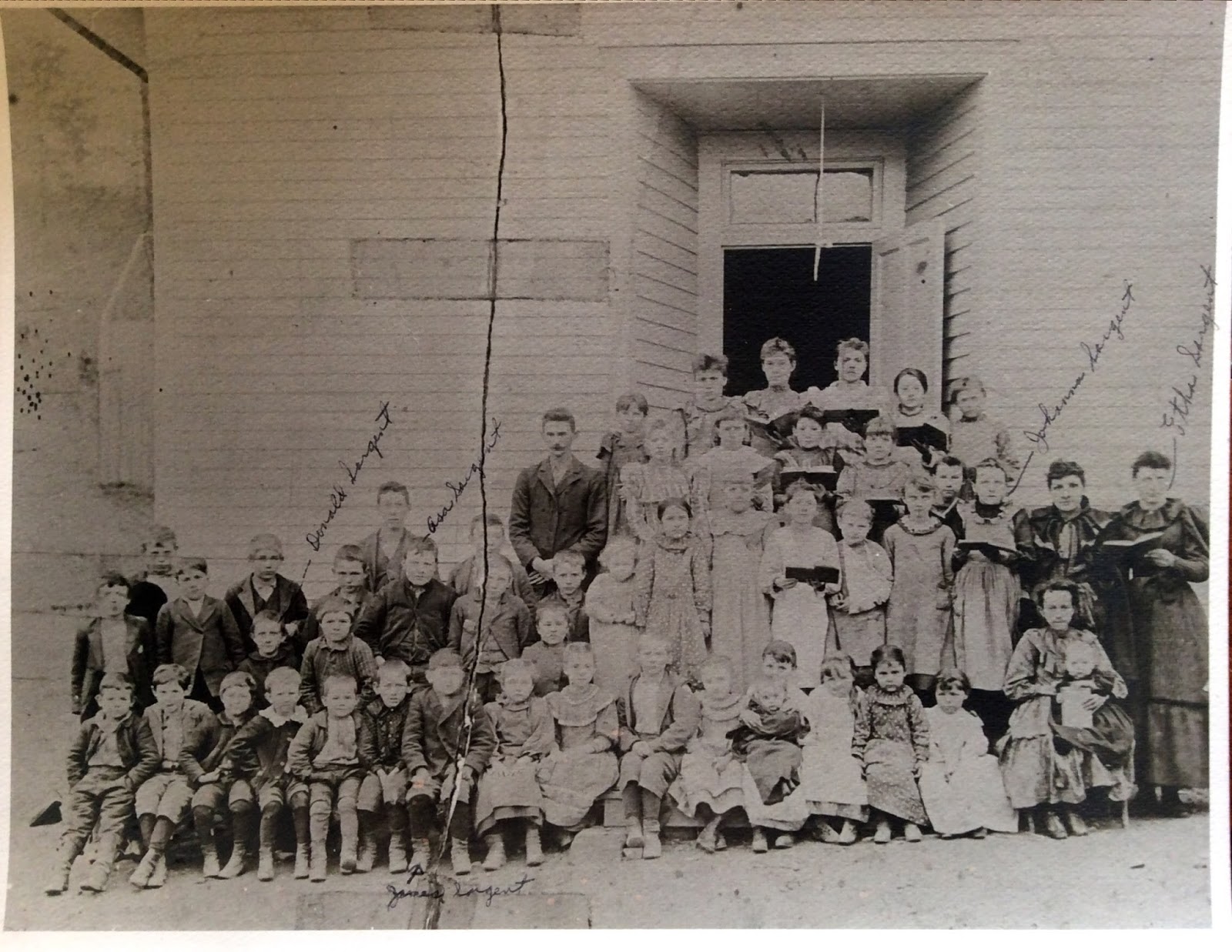
Holt School in McCameron Township, Martin Co., Indiana 1898
Four of the Sargent siblings - Donald age 6, Asa age 12, Johanna age 10, Etha age 16
Sargent Family Collection
Donald Sargent went on to complete 8 years of common school and then in 1911 at age 16 got his certificate for mining. Donald older brother only completed 3 years of school. He was 10 went his father died and he became a laborer on the farm. Donald's younger brother completed just 6 years of school.  His other siblings all died before the 1940 census.

By the next generation, all the children graduated from high school. Although none of my aunts or uncles went on to college. Although my mother did go to a one year business school.  

Education has certainly come a long way. In 1910, 72% of all students attended a one room school house. By 1918 all states required an elementary education. And today lawmakers are talking about providing college education for everyone.