Sunday, May 10, 2015

#52 Ancestors Week 19 - There's a Way - Helen Bovenschen & 7 Generations of Mothers


Amy Johnson Crow at No Story Too Small has a weekly challenge to write the stories of your ancestors. This is week #19 and the suggested theme is THERE'S A WAY. I am highlighting Helen Bovenschen and the mother's in this line.

I was looking for a way to incorporate Mother's Day into this week's challenge. I have been working on my grandfather Alfred Moehlmann's writings and so I decided to honor his wife, my maternal grandmother, Helen Margaret (Bovenschen) Moehlmann 1896-1986. I thought I would highlight her life in pictures. 

1987

Helen Margaret Bovenschen between older siter Tressa
and younger sister Grace c. 1897
from Moehlmann  Family Collection

1910

Helen Margaret Bovenschn - Confirmation Photo 1910
from Moehlmann Family Collection

1918

\
Helen Margaret Bovenschen c. 1918, in front of  Bovenschen home
from Moehlmann Family Collection

1922

Helen Margaret Bovenschen Moehlmann with husband Alfred
and first born child Harold. 1922, Linton, Indiana

1925

Helen's Family in 1925, Jasonville, Indiana
Alfred, Jane (my mother), Avery, Harold
from Moehlmann Family Collection

1955

Helen with her children, their spouses, and grandchildren in 1955 at her home in Linton, Indiana.  L to R: Arnold & Jane Sargent (my parents), Helen and Butler Rhodenbeck, Margaret & Abe Moehlmann, Vera & Bill Moehlamnn, Alfred & Helen Moehlmann, Tuney & Patty Moehlmann, & son Jon  Sitting in front: Lynda & Randy Sargent, Mike Rhodenbeck, David son of Abe, Terri & Sue Anne daughters of Bill, Pam daughter of Tuney. Three more grandchildren were born after this picture - Melynda & Brian Rhodenbeck and Jennie daughter of Abe.
But you know how it goes... I was looking at all these photographs and I started thinking...I wonder how many generations of mothers in this line I have photos for?  Imagine how excited I was when I realized it was seven.  So I found a way to put all seven generations is a collage.


Gesena (Memering) Heitman 1818-1893 mother-in-law of
   Anna (Ramacher) Heitman 1849-1908 mother of
      Gesena (Heitman) Bovenschen 1867-1933 mother of
         Helen Margaret (Bovenschen) Moehlmann 1896-1986 mother of
            Esther Jane (Moehlmann) Sargent 1924-2008 mother of
               Lynda Lee (Sargent) Towles mother of
                  Jeannie Towles mother of Nathan
                   

HAPPY MOTHER'S DAY EVERYONE!


Friday, May 8, 2015

From Single Life to Benedict - Part 2 - Big Events in 1922

The second year of marriage for Alfred and Helen (Bovenschen) Moehlmann is very eventful, as Alfred tells it:
"About this time, I got a promotion at Tower Hill – I was on a steady monthly salary of 24000 a month and was the weigh boss and general bookkeeper.  I rode the miner's train from Linton to Midland and walked from there to the mine a distance of a little over a mile.  The train left Linton at 6 o’clock and we got back about 5 pm.  Had to leave home about 5:30 in the morning and it was a common sight to see fire spouting from chimneys where the soot had caught fire.  In those days we had coal stoves, both kitchen and heating and usually to start a fire, kerosene was used and a liberal charge of “coal oil” generally started the soot burning.
Our first Big Event was or rather happened on Jan. 15, 1922 when Harold was born.  Shortly befor the event Mrs. Bovenschen asked me if I had some good whiskey in the house and I told her I didn’t have any.  She simply said, “Get some.”  I didn’t ask any questions but I wondered where I could get some since prohibition was the law.  I finally went to Avery Murray who had a Drug Store and of course he said he would have to have a doctors prescription.  When I told him my story he sold me a pint.  I think one of the ills of today is that fathers don’t witness child birth.  The idea of pacing hospital floors has its anxious moment to be sure but to witness a birth is frightening.  You see the pallor of death and the birth of a new soul in the form of an infant child.  After the anxiety was over I still wanted to know what the whiskey was for.  I soon found out, Mother Bovenschen put some warm water in a teaspoon, put a few drops of whiskey in it and that was the first nourishment the baby got.  Then she told me that it was what her mother did, that all of her own children got the same start and none of them even had the colic.  There must be something to it for I can’t remember that we ever had to walk the floor with any of our children with the colic and they all got the same treatment except possibly Helen M. who was born in the hospital, but I did tell the nurses I would appreciate it if they would follow the same procedure.
Alfred, Harold, Helen Moehlmann, 1922
Moehlmann Family  Collection
In 1922 we had the long Coal Mine Strike – from April 1st to September.  I guess I was holding my luck for being a monthly I received my pay straight through the strike – But that year we experienced some anxiety.  We first had a painful experience with Harold; he was crawling on the floor and ran a needle with a black thread in the fleshy part of his hand and the needle broke off somewhere in the hand; when we tried to pull on the thread it “gouged” deeper in the flesh.  We took him to the doctors and 3 doctors and a nurse (Drs. Craft, Fleetwood & Thayer & nurse Mrs. Hubert Heston) had to cut the needle out – Mom about passed out and I had to go down stairs for fresh air. 
Then on Thanksgiving Day we were at Uncle Karl and Aunt Annie’s for dinner and all the Bovenschen family was there.  Harold was sick and cried constantly & Mrs. Bovenschen said we had better take him home and get a doctor, which we did. At first the doctor thought it was a cold but he seemed to get worse and on Sunday morning Dr. Porter said he had pneumonia. I think it was the Sunday that Aunt Tress & Uncle Paul were married; anyhow Mrs. Bovenschen came that afternoon and her help was a big reason of his recovery.  Also in January of 1922 I was elected as secretary to the Consistory of Saron’s Church.  This was the first office I ever held and with such devout men as Mr. Bovenschen, Herman Schloot, & Jake Hahn;- elders; Hubert Bredweeg, Otto Harting & Wm. Kramer Jr. – deacons; and trustees Fred Strietelmeier, Wm. Harting and Ernie Steward.  I learned a lot."
Boy there were lots of ups and down during the couple's first year of marriage.  A promotion, then Harold's needle accident.  Our daughter, just prior to her first birthday, fell and had to have stitches. I remember how my husband said "No problem, I'll hold her while they sew her up."  Except just moments later they were bringing him to the waiting room - white as a ghost. So I can sympathize with my grandparents.  

The two articles below announce the beginning of the miner's strike.


The coal miners strike had quite an impact on the area as it lasted six months. The strike was called by the United Mine Workers of America and impacted more than 500,000 miners nationwide. 


I found it interesting that during prohibition you could get alcohol at a drug store with a doctor's prescription. Although Alfred managed without one.
This is an article in the Linton Daily Citizen on July 22, 1939 about the remodel of the Murray Drug Store. The article states that the store has held a prominent spot for the last half century. It is located at 69 North Main Street and the proprietor is  Avery Murray. The building was first owned by Henry Haseman and purchased by Murray and Dr. Berns in 1921.  In April of 1937 it became a Walgreen's agency selling Walgreen's products. Avery Murray remained the proprietor and says that it is strictly a "home-owned" store with "quality merchandise at cut prices."


 Another Bovenschen sister is married. There are just three of the seven children left in the home of William Bovenschen. It's apparent that they are a close family. Alfred has mentioned many gatherings at his in-laws home.


Alfred mentioned being elected to the consistory in 1922.  It appears he did a good job as he is re-elected in 1923, along with his father-in-law who was elected deacon for another three years.

Thursday, May 7, 2015

#52 Ancestors Week 18 - Where There's a Will - "Will" Bovenschen


Amy Johnson Crow at No Story Too Small has a weekly challenge to write the stories of your ancestors. This is week #18 and the suggested theme is WHERE THERE'S A WILL. I am highlighting my great great grandfather WILLIAM HENRY BOVENSCHEN.

William Bovenschen, my great grandfather, was always known as "Will".  He was born in Greene county, Indiana in 1866, the son of a farmer who also became a prosperous farmer. Will died in 1947 so I never knew him. However, his son-in-law, my maternal grandfather, wrote quite a bit about Will.  Here is are several excerpts that describe the man he knew.
" ..His wisdom in church affairs rarely was challenged because mainly he was just.....There was something about him that appealed to people. At threshing time, corn shredding time, public sales in in town it seems like a gang was always around him and you knew he was around by his hearty laughter. ...I never saw a family more closely knit together than his. After his children were all married, this unity still exited...He loathed idleness ad I often heard him say that you had to keep kids busy and have chores for them to do...It seemed to me he deplored poverty in the sense that where there is a will there is a way. Through hard work and good management he was always financially secure."
The William Bovenschen Family c. 1910 - Sisster back row: Bernice, Grace, Tressa, Anna,  Ruth, Helen
Front: Will, Wayne, Sena
from Moehlmann Family Collection
Bovenschen Siblings c. 1950. Standing: Tressa, Wayne, Anna
Sitting: Bernice, Ruth, Grace, Helen
from Moehlmann Faimly Collection
William Bovenschen
from Moehlmann Family  Collection
From the writings it is easy to see that Will was a self reliant man. He did not retire or sell the farm and move to town in his later years.  According to his son-in-law, Will considered his farm his hobby. 
Linton Daily Citizen, 19 June 1947, page 1
from Moehlmann Family Collection
At age 81, Will is climbing a tree to trim it.  In the Indianapolis paper they next day, June 20, he is quoted as saying, .."the next time I will be more careful." Even after being hurt his comment isn't that he will not climb a tree again but rather talking about the next time.

Here are the entries in his son-in-law's diary in days following the fall:

     June 18 - 60 degrees at 7am, rained all day, Grandpa to the hospital
     June 20 - Mom brought Grandpa's car here. Grandpa improved in early morning. Went to the hospital to see Grandpa.
     June 23 - Mom stayed with Grandpa at nite
     June 24 - Grandpa's cow to us
     June 26 - Mom stayed with Grandpa
     June 30 - Grandpa not so good
     July 1 - Grandpa worse
     July 2 - Grandpa failing
     July 3 - Grandpa critical
     July 4 - Mom sat up all day and nite with Grandpa
     July 5 - Grandpa very low
     July 6 - Grandpa died at 1:10 am, funeral arrangements 10 am, flowers taken care of
     July 8 - Grandpa's funeral at 2 pm
     July 9 - All family to Ruth's to hear Grandpa's will. Heirs met at Aunt Ruth's at night.
     July 13 - All heirs met here - appointed me to act as their agent.

In later writings here is how Alfred relates handling of the will:
 "The family gathered at our home and decided to disregard a will that was made several years before and although the distribution of the estate was possibly well equalized at the time it was made, the changing condition of time made it such that a few would benefit more than others, so they asked me to be the agent and settle the estate.  It was a big job, there were 7 heirs to satisfy.  The Ax & Fry building and the Farms had to be disposed of. There was the tax angle, inheritance, federal, state and county. I made trips to Terre Haute and Indianapolis on federal tax questions.  Several trips to Terre Haute to see officials of the Maumee Colleries Co. to sell the farms for coal.  I had to sell the farms on a contract basis involving five yearly payments which made a long period of procedure before final settlement.  We had permission to farm the land until it was paid for and Uncle Russell helped me on this phase. Well naturally final settlement was made with all the heirs. I must say that all the heirs were nice and didn’t cause any trouble.  That is surely a credit to a fine family."

Friday, May 1, 2015

From Single Life to Benedict

I had to look up the term "benedict" after seeing the title that Alfred gave to this section of his story. According Webster's dictionary a benedict is  "a newly married man who has long been a bachelor." In 1921 Alfred is 26 years old and Helen is 24. He's not that old, although many of his friends have been married and started families. This entry tells about his wedding day and the next few months of married life.
"March 26, 1921 was a beautiful day – bright sunshine all the day but a strong wind, yet it was warm.  I cranked up the Model T Ford and went to Mom’s house.  The trip to Bloomfield was a sort of joy ride.  I don’t think we ever had been together in the morning befor.  Yes, we were sort of embarrassed when we went to the County Clerks office to
get our marriage license.  I don’t remember for sure but I think the fee was 250, anyhow, I pulled out a ten dollar bill and the clerk jokingly said that the bride gets the change.  On our way back the strong wind broke one of the straps that held the top to the windshield of the car so we had to leave the top down (convertible?)  We stopped in Linton and got a couple of boxes of cigars and a quantity of candy for we knew we would have a big charivari.
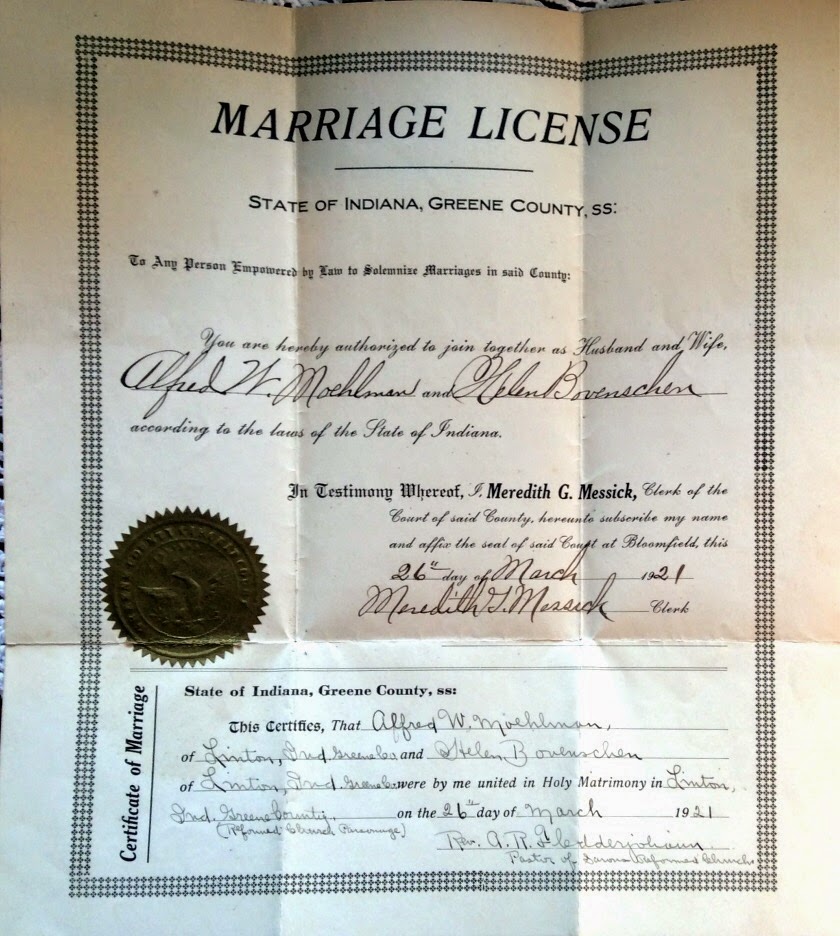
Marriage License issued in Greene County Indiana 26 Mar 1921
for Alfred W. Moehlmann and Helen Bovenschen
from Moehlmann Family Collection
I am sure I ate dinner at Mom’s home and then was the long wait for 6 pm the hour set for the ceremony.  Cranked up the Model T – Mom was ready and dressed in a new suit, hat and all, Aunt Grace and Uncle Russell were waiting too for they were our witnesses and we drove to the parsonage at Sarons Church and were married there.  Rev. A.R. Fledderjohann in a simple ceremony – not even a ring – I had a feeling of my own, relative to a wedding ring.  I saw the wide, plain band wedding ring my mother wore and somehow I felt it took something more than a ring to make marriage a success and also a happy one – I felt that if we would make God our Boss and we would be His Stewards, we would have no controversies. 
Marriage Certificate issued by Saron Reformed Church
for Alfred W. Moehlmann and Helen Bovenschen
from Moehlmann Family Collection
Rev. Flederjohann went back to Mom’s house where we had our wedding supper with Mom’s folks and my mother & Uncle Dietz the only guests.  Then the wait for the gang to charivari and they didn’t disappoint us.  Even had to ride a rail.  They stayed with us untill 2 am.  The following day was Easter Sunday.  The day started out nice and clear but a big dark band of clouds was pulling in from the west and by the time we left for Sunday School it started to rain.  Aunt Grace & Uncle Russell went with us and during church service I never saw the sky light in the church get such a pelting of rain.  After church we went to Uncle Karl and Aunt Annie’s for a surprise birthday dinner for Uncle Karl.  Again just north of the Winters Corner the rain came down in torrents.  At that time this was a clay road.  All of the Kramer family and the Bovenschen family were at the dinner.
The parsonage is located to the right of the church.

 The first week we stayed with Mom’s folks.  I think that was a custom required by Mr. Bovenschen. The next day (Monday) I worked in the mine again.  That noon as we were about to eat our lunch on the “Parten” (where loaded cars were gathered to be pulled to the mine shaft) and I made the remark that I would eat the first dinner that my wife had fixed for me.  Well what happened was that Uncle Dietz and me had the same kind of lunch pails and we got them mixed in the washhouse, so he ate the first lunch that Mom made.  The worst part of it was that I didn’t eat any of our wedding cake at the supper and the last piece was put in the lunch pail so I didn’t get any of my wedding cake.
 The big mistake we made was that we started off to live with my mother and Uncle Dietz.  They insisted on this arrangement for my mother still was unable to take care of the house due to her surgery the fall befor.  I was afraid that the arrangement wouldn’t work out - account of my mother’s temperament.  It didn’t and the least said the better - So we set up housekeeping to ourselves at 189 C St. N.E. in Linton the middle of November. 
In the mean time, Aunt Grace and Uncle Russell were married and the week befor we moved into our new home, while we were staying at Mom’s folks I had the misfortune to step on a rusty nail in the mine that punctured my foot by entering the ball of my foot and coming out at my instep.  They called Moms folks that I was injured at the mine and asked Mr. Bovenschen to come there at once.  Mom was pretty worried but we drove past the house on our way to the doctors and assured her that I wasn’t hurt too bad.  We went to Dr. Thomas who had his office where Welch & Cornett are now located.  I had a painful foot that gave me a lot of trouble.  I took a “shot” for lock jaw.  As long as I could keep my foot higher than my head it didn’t hurt but would throb so I couldn’t stand it if I lowered it.  This lasted for about a week; then I was on crutches for a couple of weeks.  So we started our new home with me on crutches.  I think we started housekeeping the day befor Thanksgiving for Aunt Grace and Uncle Russell ate their first Thanksgiving dinner with us."
Grace Bovenschen Pope & Russell Pope
from Moehlmann Family Collection

How the the customs of dating have changed since Alfred's time. His wedding day is the first time that he and Helen have been together in the morning.  Again I had to look up the meaning of the term "charivari".  Here is a page explaining the practice. 


Wednesday, April 29, 2015

#52 Ancestors Week 17 - Prosper - Frederick Henry William Moehlmann


Amy Johnson Crow at No Story Too Small has a weekly challenge to write the stories of your ancestors. This is week #17 and the suggested theme is PROSPER. I am highlighting my great great grandfather Frederick Henry William Moehlmann.


I have written about my 2x great grandfather before but it was in relation to having a long marriage.  This week I want to talk about his successes. I so admire all of my immigrant ancestors who had the courage to travel to new lands, seeking their fortune.  Frederick and his wife Ida Sophia came to the US in September of 1867.

I don't really know the circumstances around the decision to leave Beckedorf, Germany and settle in Indianapolis, Indiana.  There had been recent changes in the government with the formation of The North German Federation after the Austro-Prusian War ended in July 1866. The following year a new constitution was adopted.  I am just beginning to research the history of Beckedorf, where he was born, but it certainly seems logical that all the political changes may have had an impact on Frederick.  

One think I know for sure it that the decision for Sophia to travel with him was most likely last minute. There was a notation made in the marriage record at the church in Meinsen on 15 Aug 1867 stating:  "Very short notice was given for intended marriage. They married at 7 in the evening because their ship is going to America."  Also the manifest for the ship "Hansa" which arrived in New York on 2 Sep 1867, listed Ida with her maiden name of Krentler.
Passenger List for the "Hansa" 

Just three years later in the 1870 census, Frederick is working as a railroad laborer and has real estate valued at $1800 and they have two children. By 1880 the family has grown to six children and Frederick is still working as a laborer. According to an 1890 Indianapolis directory Frederick is working for Hendrickson, Kepler & Co., a hat and glove maker. By 1910, 72 year old Frederick is the owner of a cigar stand and owns his home free and clear.  

Frederick Moehlmann - Death 1911
Indianapolist Star April 21, 1911
Here is the transcript of his obituary:
                             "DADDY" MOEHLMANN IS DEAD
                                 KEPT STAND IN COURT HOUSE
 Paralysis Attack Causes Death of
 Familiar Figure, Whose Name Was
    Known to Few.
 ---------------------------------
Frederick W. Moehlmann, known universally as "Daddy" at the Court House where he had kept a cigar stand is dead.  Few of his many patrons knew his right name, and as he was away from his stand for only a little more than twenty-four hours before he died, few knew of his illness.  He became ill Tuesday afternoon and when he made his last sale, a 5-cent piece of chocolate, he was hardly able to make change.
  He protested at that time he was only slightly ill.  His little grandson,who had gone to the  Court House in the afternoon had to assist him in locking the case which contains the cigars, tobacco and candies.  Shortly after Mr. Moehlmann reached home he suffered a stroke of paralysis, which resulted in his death at 10 o'clock yesterday morning at his home, 607 McCarty street.
                                       WAS AT STAND DAILY.
 "Daddy" as he was called by every one about the Court House for the last two years had become almost a fixture.  He opened his stand regularly with the offices and courtrooms and closed promptly at 5 o'clock in the afternoon. He was always ready to exchange a pleasant word with his customers.
Mr. Moehlmann was born in Germany seventy-three year years ago and came to Indianapolis forty-three years ago.  For twenty-five years he was connected with a hat company.  About two years ago he purchased the Court House cigar stand.  He is survived by two sons, Frederick and Lewis Moehlmann, and two daughters, Miss Mathilda Moehlmann and Mrs. Anna Lichtsinn.  The funeral will be conducted at 2:15 o'clock Sunday afternoon at St. Paul's Evangelical Lutheran Church.  Burial will be made in the Lutheran Cemetery.
I think Frederick lived the American dream that allowed him to assimilate in a new culture, raise a family, buy a home, and eventually buy his own small business.  


Sunday, April 26, 2015

My Last Two Years in Single Life

We are back to Alfred Moehlmann's story As I Was. Alfred has just been discharged from the service and is back in Linton, Indiana. It is January 1919 and Alfred will be 25 in October.  He is making plans for his future.
"I got back home to Linton from the Army on a Sunday night.  A lot of people rode the trains at that time and there was a big crowd at the I.C. Depot that night, not to see me, but seeing off and others arriving, but befor the train stopped I saw Mom, Aunt Grace and Uncle Russell Pope.  The some reason when I got off the train, Aunt Grace was there and gave me a big “smooch” which Mom didn’t like at all.  Well the Big Studebaker Touring car was here and with the driver being Mom we soon were home.  We had a lot of things to talk about and Uncle Russell left a short while befor me.  Then Mom flashed the letter in front of me that the girl from Asbury Park, N.J. had written her and I had some stammering and explaining to do. 
  After being home a week or so I began making contacts for a job.  My old jobs were filled and the promises that you would get your old job back when the war was over was forgotten,  So I got a job at Black Creek No. 2 mine known as North Linton as a coal miner.  I didn’t like the low coal but kept my eyes open for something better.  While working there Uncle Russell and I took Mom, Aunt Grace and Aunt Tress down in the mine and showed them the inside for their first time.  They were a sore bunch of girls after walking and crawling a mile or so to where we worked. 
The 20th of June 1919 I got a job of keeping books for the Gladstone Coal Co., at Petersburg, Ind.  But I only stayed there 4 months.  First it was too far from home and secondly they wanted me to weigh coal at the mine and work on the books at night and idle days.  I quit and came back to Linton.  (Befor I went to Petersburg, in fact befor I started at North Linton I bought a driving horse, Jeff.  He was a fractious animal and you could hardly get in the buggy until he started running  A few months latter I bought a Model T Ford Touring car 56537 – no starter or heater – (30 x 3 tires in front & 30 x 3 ½ rear – non demountable rims.)  I again got a job at North Linton mine but had a much better place on the 7 South off the main East with coal about 4 ft. high and made pretty good money. 
Mom began showing signs of wondering if our steady company meant anything, anyhow she had a perfect right to wonder.  Finally we decided on getting married and set the date for March 26, 1921 about a year off.  Our idea of setting the date a year off I felt like I needed more money to start house keeping.  We told Aunt Grace and Uncle Russell about our plan and they wanted us to wait until May and have a double wedding, but we decided on our date.
In the spring of 1920 Albert Kramer and I got a job at Tower Hill Mine at Midland.  I was the first time I ever worked in high coal.  The seam of coal was from 6 to 8 feet high.  The mine had not been in operation for many years and we got jobs as “Jerrymen” really ordinary labor at 750 per day.  We had good steady work even on Sundays and I built my bank account up considerably that year.  The close association that the four us – Mom, Aunt Grace, Uncle Russell and I had made us all very close to one another and this could be defined as “Love thy neighbor as thyself.”  This was not a passionate love but a love that kept us very close to each other both during courtship and after we were married.  I can’t remember too much of our courtship – I guess we were mostly Parlor Sitters which we shared most all the time with Aunt Grace and Uncle Russell.  Of course we started “sparking” in a horse and buggy and wound up in a Model T Ford.  One Sunday the girls arranged for a picnic supper.  Mom drove the family Studebaker and we took a drive that afternoon and went to Freedom on what now is State Road 67.  At that time it was just a gravel road.  Back in those times you always had spark plug trouble and everybody carried a supply.  We had it on the outing climbing a long hill.  It was up to Uncle Russell and me to do the changing – Soon a crowd surrounded us.  I think they must of thought we were “Big Shots” driving a big 7 passenger Studebaker or the 2 good looking girls in the car was the attraction.  (It is to remember that a Studebaker back in those days was a car of distinction and only prominent people could afford one.)  When we got back home, Wayne who was quite young then, checked the speedometer and told his Dad how far we had driven.
Alfred & Helen on left and Russell & Grace on right c. 1920.
Both pictures taken in front of the Bovenschen family home.
Moehlmann Family Collection
 During my last two years of single life it wasn't all courtship and work for I got a mania of wanting to see the 500 mile automobile races at Indianapolis on Decoration Day – Albert Kramer and I went to see the races in 1919 in his Saxon 6 cyl. Touring car.  We left Linton around midnight and got to the speedway at 5 am.  It was a long dusty trip – All gravel roads. In those days we went through Martinsville; the following year we went with some fellow from Midland who worked at Tower Hill Mine in a Dort car.  Also in 1919 Albert Kramer and I took a sudden notion while working at North Linton to go to the State Fair.  The “Turn” which means in the mine cars was slow so we talked the Mule skinner (driver) to give us a couple of “fast” cars – we loaded them quickly, was washed up by noon, went home, changed clothes, back to Linton caught a train at 1:15 (over what is now the St. Paul R.R.) to Beehunter and a Pennsy train from there to Indianapolis.  The following year Sheldon Goodman and I went to the Fair for a couple of days.  He like myself liked horse racing (harness) and we sure saw a lot of it the 3 days we were there.  On our trip home (the I.C.R.R.) I told him that Mom and I were going to get married the following March and I can’t help but see the expression on his face – Sheldon had a deep affection for Mom and I was in a sense sorry for him for he was one of my best friends. 
 Sometime during the fall of 1920 my mother went through a very serious operation at St. Anthonys Hospital at Terre Haute.  Mrs. Bovenschen went up with me the day of surgery and after the operation Dr. Knoefel told me her chances of recover was far from good.  I made several trips up there on a train and one day the Doctor asked me if I could bring some wine up for the following Sunday.  This was during the Prohibition and liquors were hard to get, but he knew Uncle Dietz made a keg of grape wine every year.  Uncle Dietz was out of it however so I went to Jake Cerar for I knew he also made wine.  He didn’t have but a little on hand and was reluctant to let me have any but when I told what I wanted it for he gave me a quart and would have no pay for it and said if I needed more he would get it for me.  It was elderberry wine and I carefully packed it in a grip and took it on the train to Terre Haute and the hospital, with a feeling that I would be picked up for transporting alcoholic beverages.  When I arrived at the hospital Dr. Knoefel was in the room and the first thing he asked me if I had brought the wine.  He had the nurse get a small wine glass, poured out a small quantity offered it to my mother and when she said she couldn’t drink the stuff, he gave it to the nurse.  Then he said, “Tillie, I knew you couldn’t drink it, I wanted it for myself, because the Shriners are getting together this afternoon and I didn’t have anything for my part of the drinks.” 
 While my mother was in the hospital, Uncle Dietz and I “batched.”  One incident in cooking experience – made a pot of rice – too much rice – wound up with more on the stove and the floor than in the pot.  After my mother came back home, we hired Ethel Higar to keep house for us. 
A week befor our wedding day I had to do the hardest job in my life.  I had to face Mom's father and ask for her hand.  I didn’t know why I feared that moment, when I was well aware that he was a stern man but a just and honorable man.  He acted like he was surprised but admitted that he detected evidence that we planned marriage."
Alfred has taken advantage of his last years as a single man by attending auto and horse racing events in Indianapolis

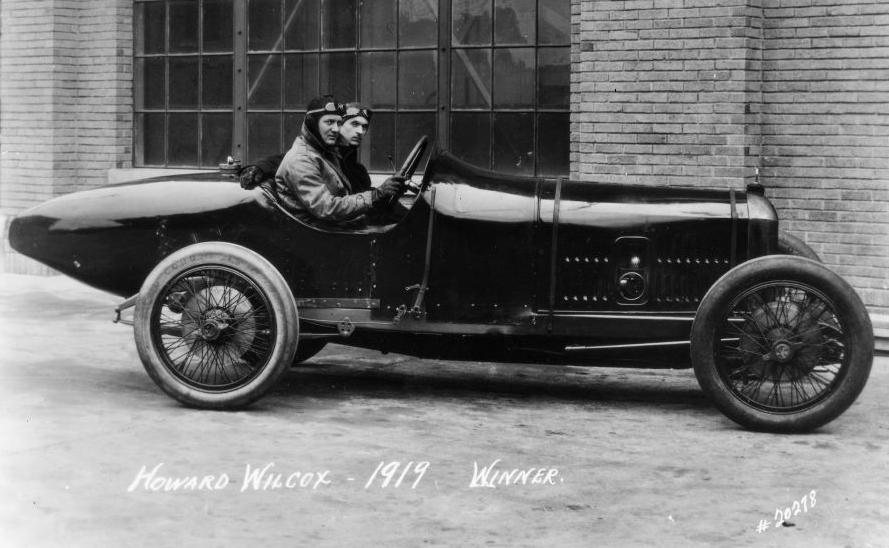
Howdy Wilcox won the Indianapolis 500 in 1919 driving a Packard.
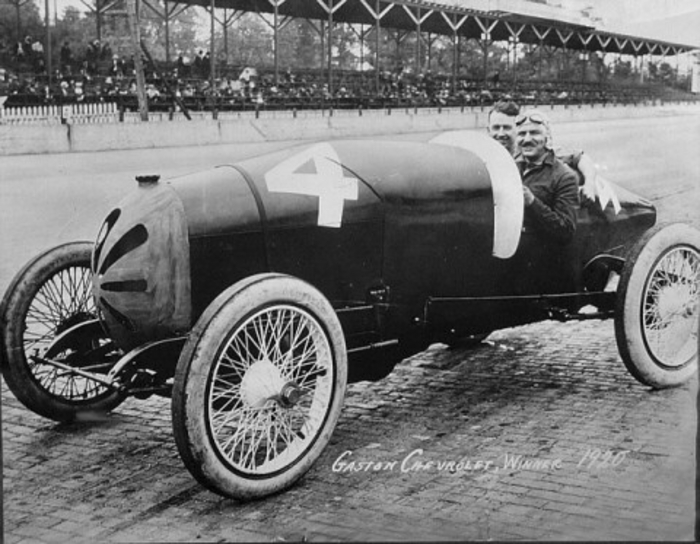
In those days the mechanic actually rode with the driver. Wilcox's mechanic in 1919 was Leo Banks. In 1920 the race was won by  Gaston Chevrolet with John Bresnahan as mechanic. It was Gaston's older brother Louis that founded the Chevrolet car company. Gaston broke the dominance of European cars winning the 500 when he did it in a Frontenac, a company he and his brother started. He also was the first to win without making a tire change.  Both of these drivers lost their lives in crashes during a race while still young men. 

1920 Winner of Indianapolis 500 Gaston Chevrolet
Besides enjoying car racing, Alfred also enjoyed horse racing.  He talked about the the horse track in New Jersey and now he is going to the Indiana State Fair to see the horse races.

The surgery of Alfred's mother left him and his uncle "Dietz" on their own. Will her long recovery have an impact on his upcoming marriage?  
St.  Anthony's Hospital, Terre Haute, Indiana
from http://brisray.com/th/tpcards200.htm
Alfred tells us about talking with William Bovenschen about his and Helen's future plans just a week before the planned marriage. It's hard to believe that the happy couple has kept their plans secret for a year.  


Thursday, April 23, 2015

Recap 1915-1920


Alfred's single days are about over.  While being drafted into the Army during World War I, his service was all state side.  He is now back in Linton, Indiana and making plans for the future. Before we move on to his next section, let's recap.  Below is a short timeline of the last five years of Alfred's life and some of the other events going on in the world. 

TIMELINE
ALFRED MOEHLMANN
Year
WORLDWIDE
-Worked in the coal mines
-Started seeing Helen Bovenschen
1915
-First phone call from New York to San Francisco
-Sinking of the Lusitania by Germany
-First transatlantic radio/phone communication – Virginia to Paris
-One millionth Model T produced
-Attends Central Business College in Indianapolis
-First time voting for president
1916
-Norman Rockwell begins illustration for Saturday Evening Post
-Average price for new car $600
-First woman elected to House of Representative

-Begins working for Vandalia Coal Company as cost accountant
-Registers for the draft
1917
-U.S. Virgin Islands purchased from Denmark for $25 million
-Drafted into the Army Signal Corps and stationed in Vermont
-Grandmother Tendick dies
1918
-Time zones and daylight savings time official established
-Air mail service started by Post Office
-Discharged from military
1919
-18th Amendment ratified – “Prohibition”
-Pop up toaster invented
-Working in the coal mines
-Sets wedding date for March 21, 1921
1920
-Railroad industry peaks
- First commercial radio station in Pittsburg
-Invention of Band-Aids
-Indiana Bell established to provide phone service in Indiana

It is now 1920 and Alfred is 25 and living with his mother and uncle.  He is working as a coal miner and saving for up for his approaching marriage.
1920 Census of Stockton Township, Greene Co., Indiana, Diedrick Tendick family
His betrothed, Helen Bovenschen, age 23, is living at home with her parents, four sisters, brother, and her 78 year old grandmother. 
1920 Census of Wright Township, Green Co., Indiana, William Bovenschen family
Helen's oldest sister Anna was married in 1913 and her next oldest, Grace, is planning her wedding for just two months after Helen's. Grace is a high school teacher. Helen's two youngest siblings, Ruth and Wayne, are still attending school.  Her grandmother, Margaret Schmidt Bovenschen, has been a widow since 1911, when her husband Dedrick died at age 78. 

So we are about to move on to Alfred's next stage. We know that his parent's failed marriage has made a huge impression on him.  He has had periods of feeling inferior and now he about to marry the daughter of one of the most respected and successful men in the county.